The Museum of Everyday Living · Housing · Work & Livelihood
How tall?
From ziggurats to supertalls: why people build up, and what decides how far
SI painting, made for this explainer: an illustration, not a photograph.
For most of history the tallest things people built were tombs, temples and towers that held almost no one. Then, in about seventy years, land prices, steel and the safety elevator turned height into floor space you could rent. This explainer walks that story and then asks the research question behind this whole estate: what conditions push a downtown to build up, for offices and for homes?
The charts on this page are read live from the Urbanicity building database every time the page loads: 135,423 U.S. buildings, 131,811 with a height, 734 at 150 m or more and 29 at 300 m or more. Heights follow the CTBUH rule: to the architectural top, spires yes, antennas no. For the research itself see CBD & Vertical Theory, How Cities Grow and CBD Maps.
Part one4,500 years of going up
Each card gives the year, the place and, where it makes sense, the height. A ≈ marks an estimate: no one measured the ziggurat of Ur or the Pharos with a laser.
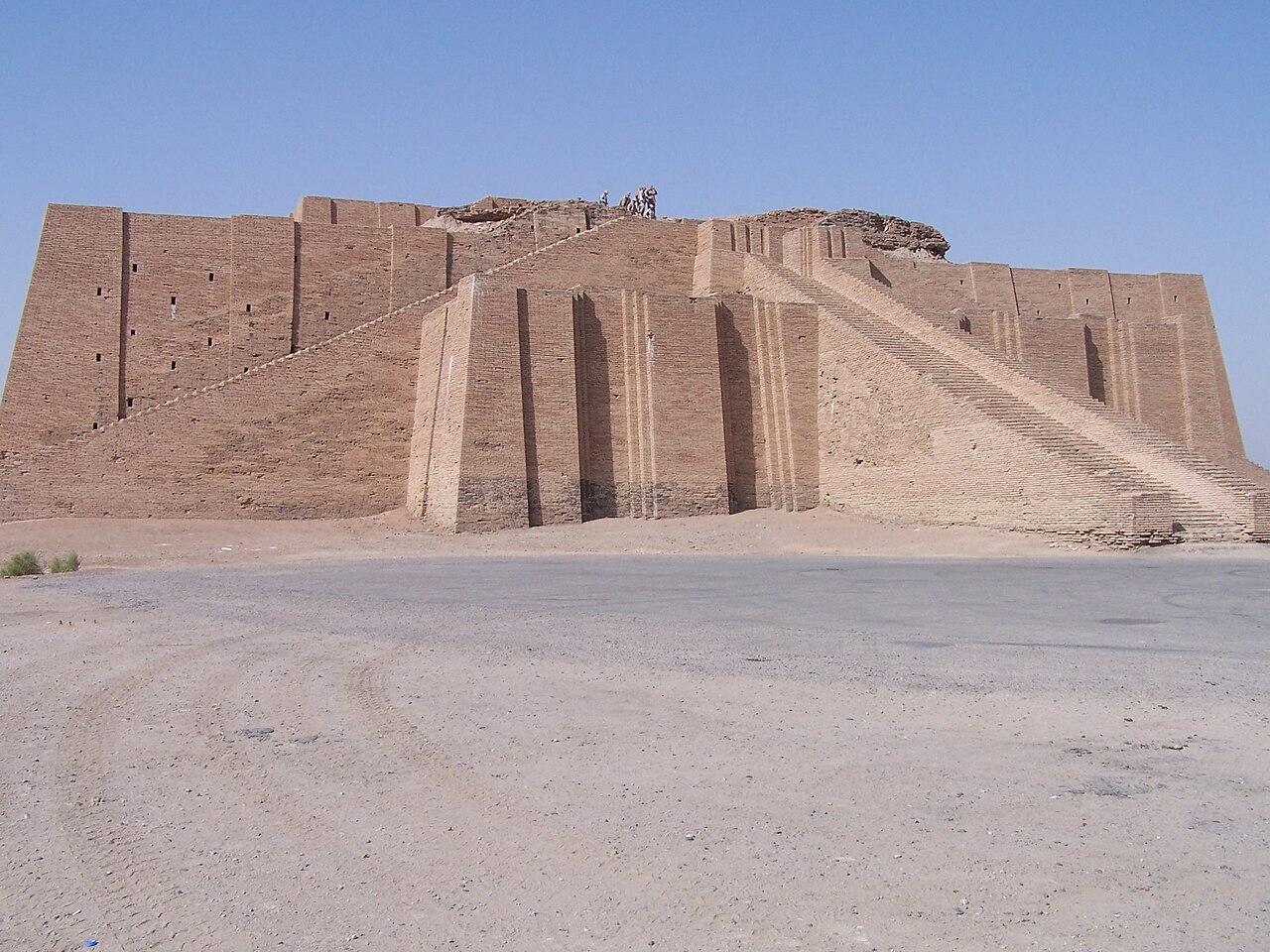
c. 2100 BCE · Ur, southern Iraq≈ 30.0 m
The ziggurat of Ur
A stepped mountain of mud brick raised by King Ur-Nammu for the moon god Nanna. Height came from mass: the building was mostly solid, a pile that could only go up by getting wider at the base. Its original height is reconstructed, not measured.
Figures marked ≈ or "about" are estimates or disputed.
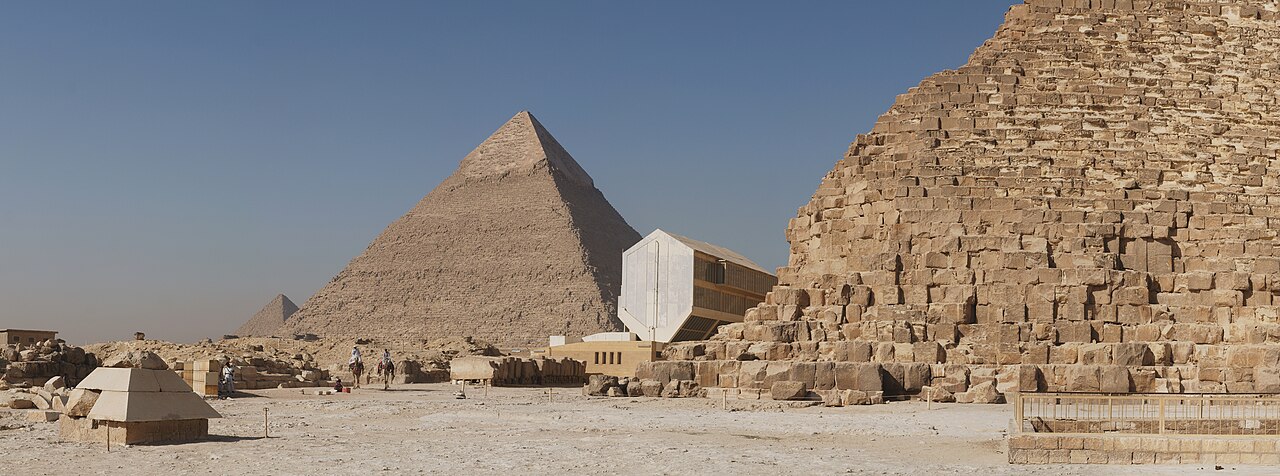
About 146.6 m when its casing was intact; about 139 m today. It stayed the tallest thing people had built for nearly 3,800 years. A pyramid answers the height question with geometry: every block rests on the blocks below, so the walls never have to hold themselves up.
Figures marked ≈ or "about" are estimates or disputed.
c. 280 BCE · Pharos island, Alexandria, Egypt≈ 100 m
The Lighthouse of Alexandria
One of the Seven Wonders, a three-stage stone tower with a fire at the top to guide ships into the harbor. Ancient writers suggest more than 100 m; it was ruined by earthquakes by the 1300s. A tall building with a job: to be seen from far away.
Figures marked ≈ or "about" are estimates or disputed.
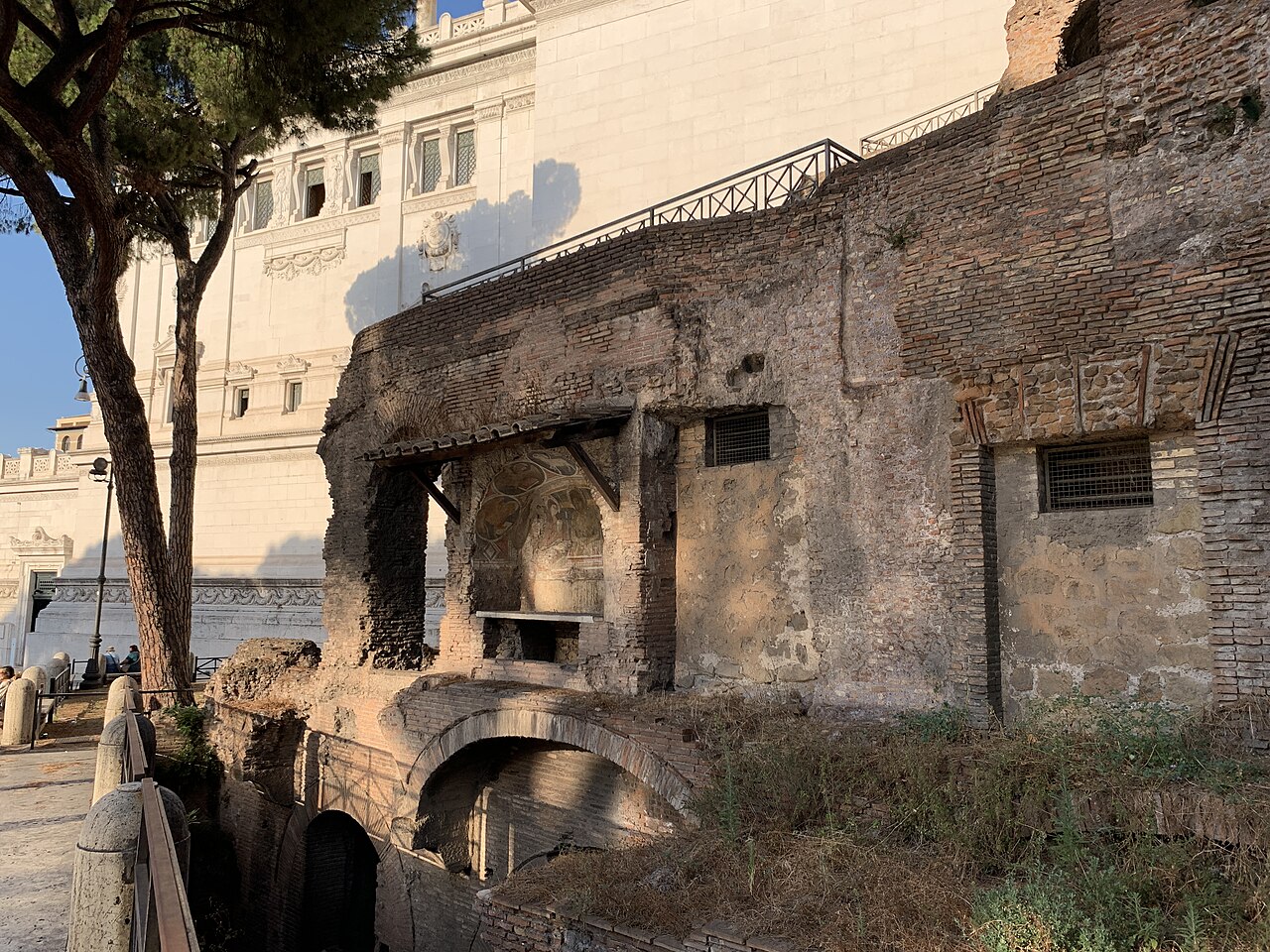
Roman apartment blocks and the first height limits
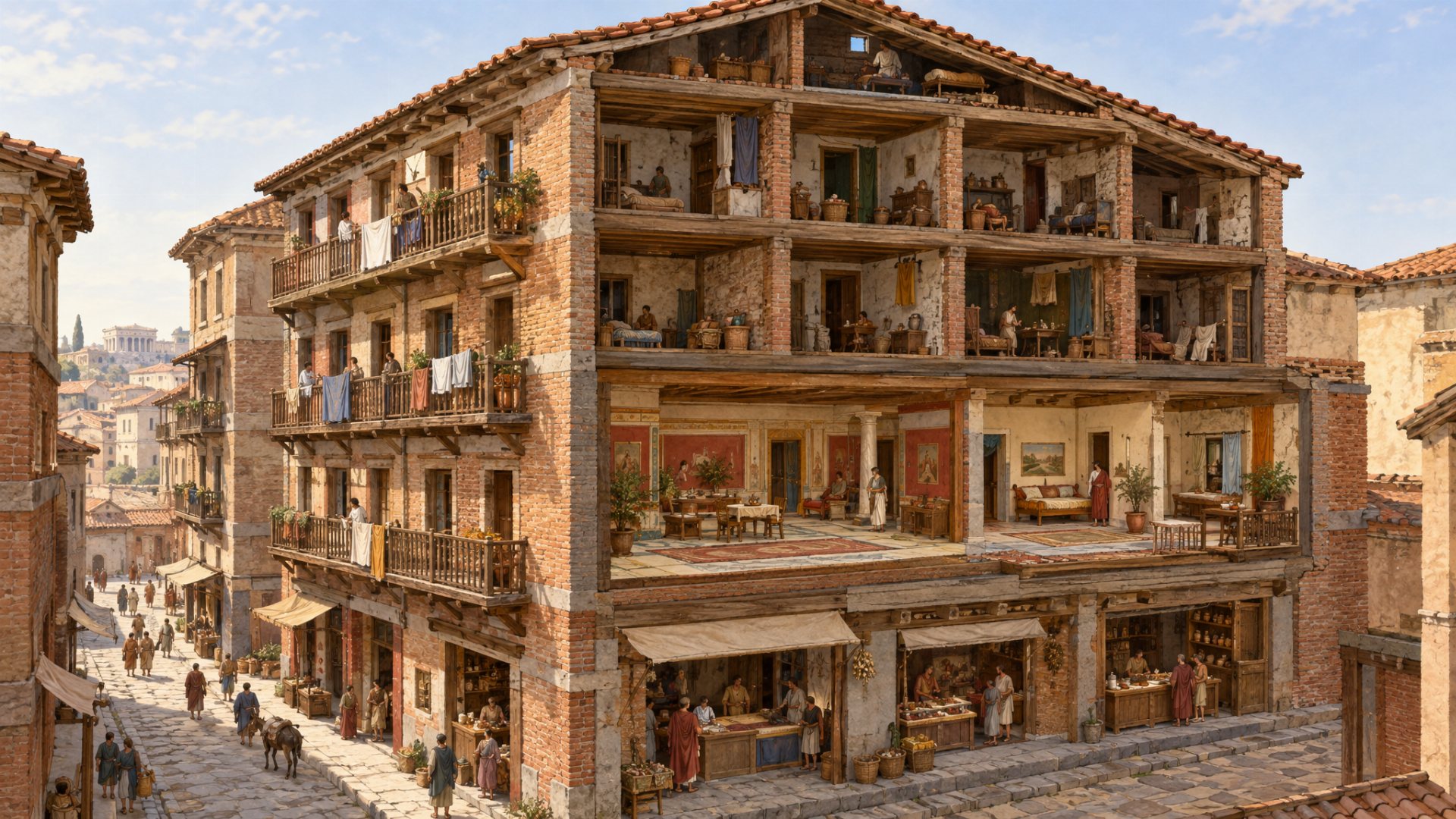
Rome packed perhaps a million people into insulae, apartment blocks of brick-faced concrete with shops on the ground floor. Tall blocks collapsed and burned, so emperors capped them: Augustus at 70 Roman feet (about 21 m), Trajan later at 60 (about 18 m), according to Strabo and Aurelius Victor. The first zoning law for height in the record.
Figures marked ≈ or "about" are estimates or disputed.
SI painting, made for this explainer: an illustration, not a photograph.
Rome is the first city where we can watch height become a housing problem and then a law. See the apartment blocks, concrete and vaults in Rome: how they built it.
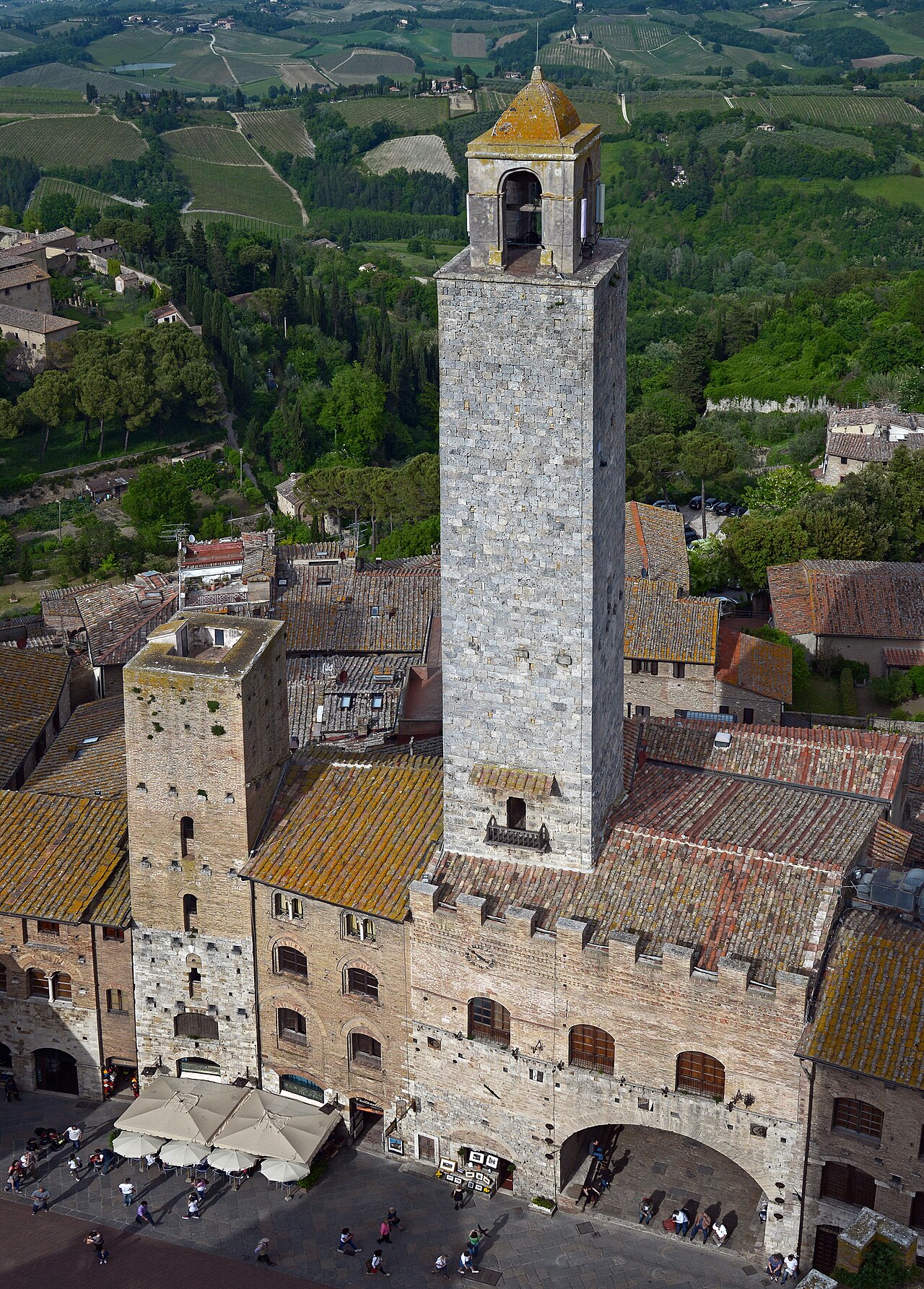
1100s–1200s · Tuscany and Emilia, Italy≈ 97.2 m
Tower houses of San Gimignano and Bologna
Rival merchant families built stone towers as fortresses and as boasts. San Gimignano once had around 72; 14 stand. Bologna's Asinelli Tower (about 1109–1119) is 97.2 m. Height here is prestige: the towers had little usable floor space.
Figures marked ≈ or "about" are estimates or disputed.
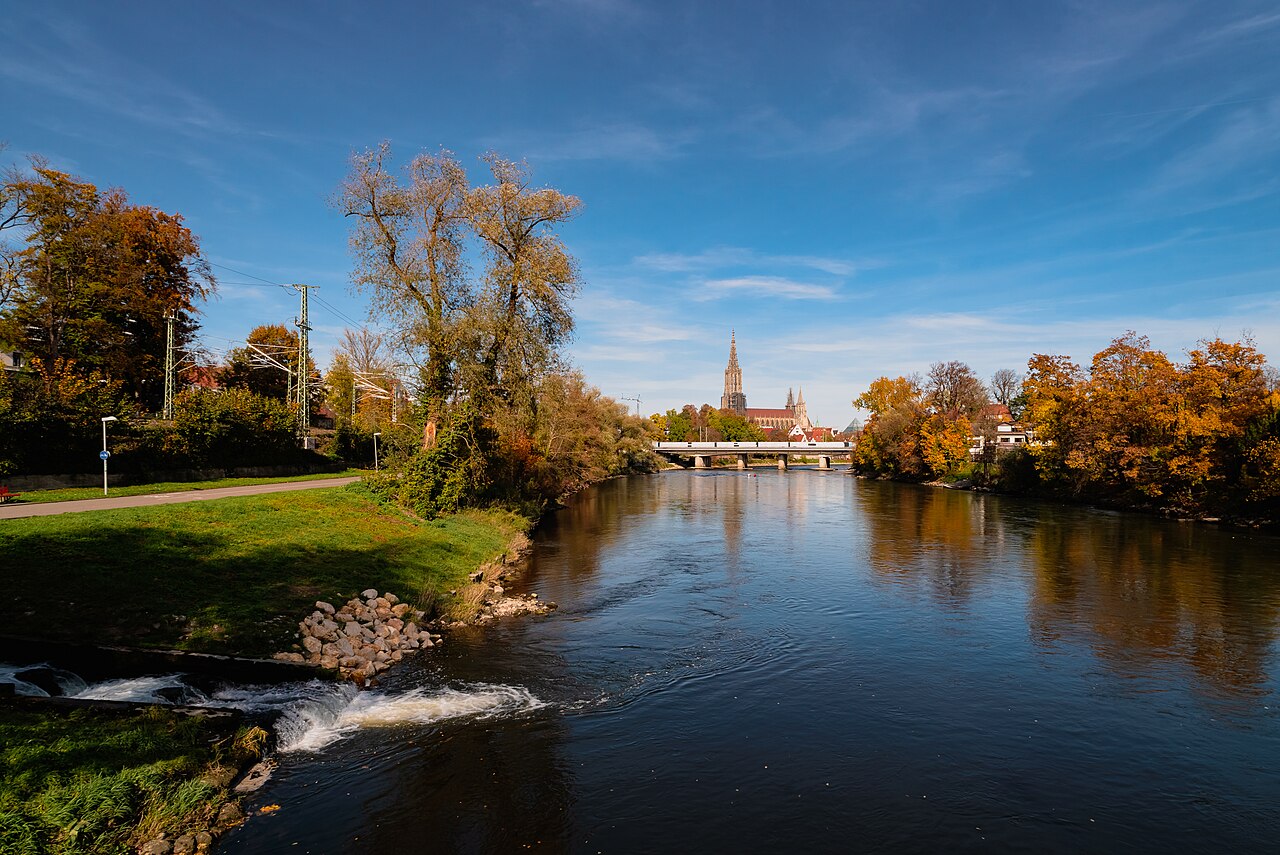
1311 and 1890 · Lincoln, England; Ulm, Germany≈ 162 m
Cathedral spires
Lincoln Cathedral's central spire (finished 1311, estimated about 160 m) finally passed the Great Pyramid; it blew down in 1548. Ulm Minster, finished in 1890, is 161.5 m, still the tallest church. Stone spires are mostly hollow ornament above a heavy base: tall, not habitable.
Figures marked ≈ or "about" are estimates or disputed.
Some 500 mud-brick tower houses of five to eleven storeys, packed inside a wall for defense against raids and floods. UNESCO World Heritage since 1982. Proof that a dense vertical town needs no steel: it needs a reason to stay inside a small footprint.
Figures marked ≈ or "about" are estimates or disputed.
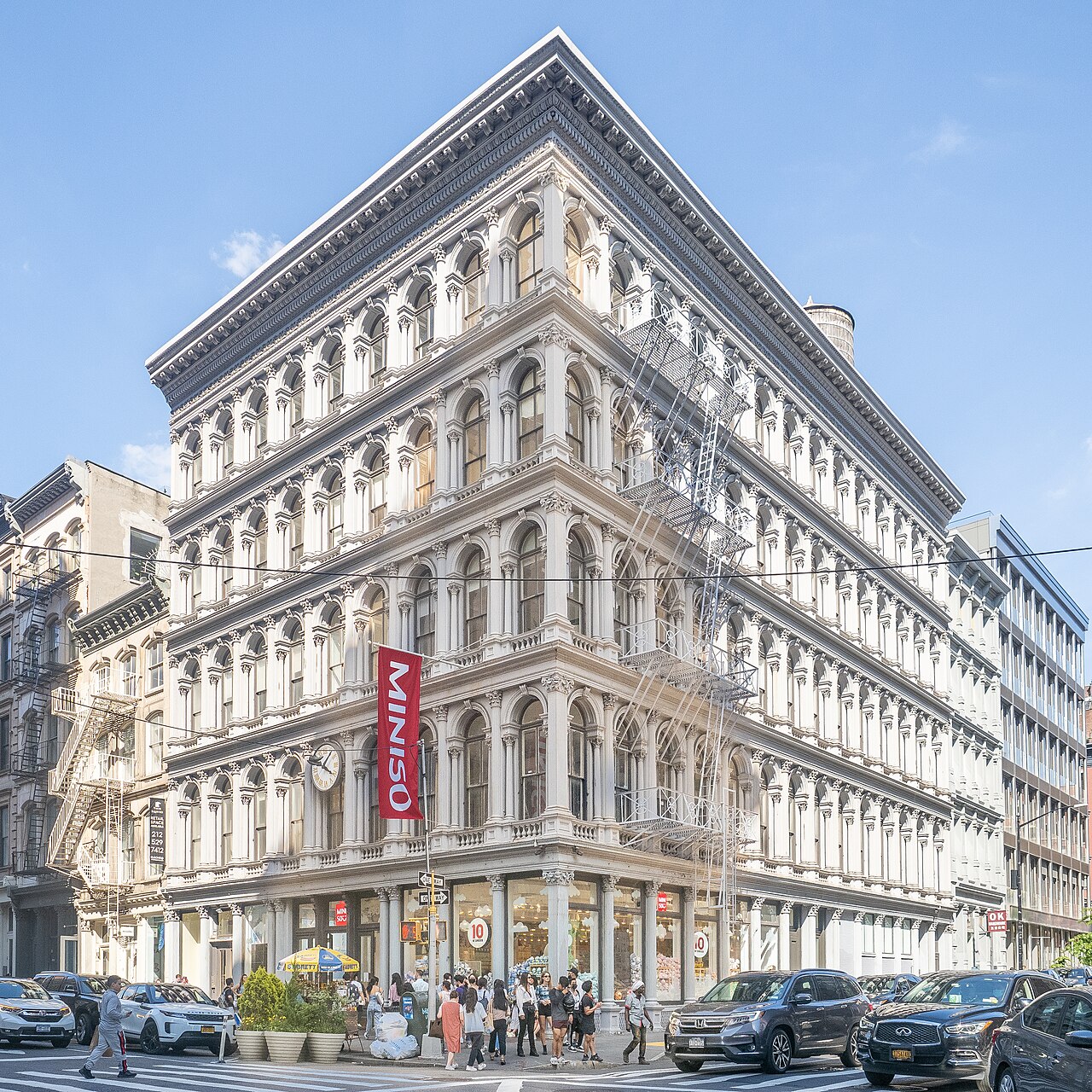
Elisha Otis showed his safety brake at the New York Crystal Palace in 1854: the rope was cut and the platform held. The first passenger safety elevator opened in the E. V. Haughwout Building in 1857. Before it, the top floors were the cheap ones; after it, they became the expensive ones.
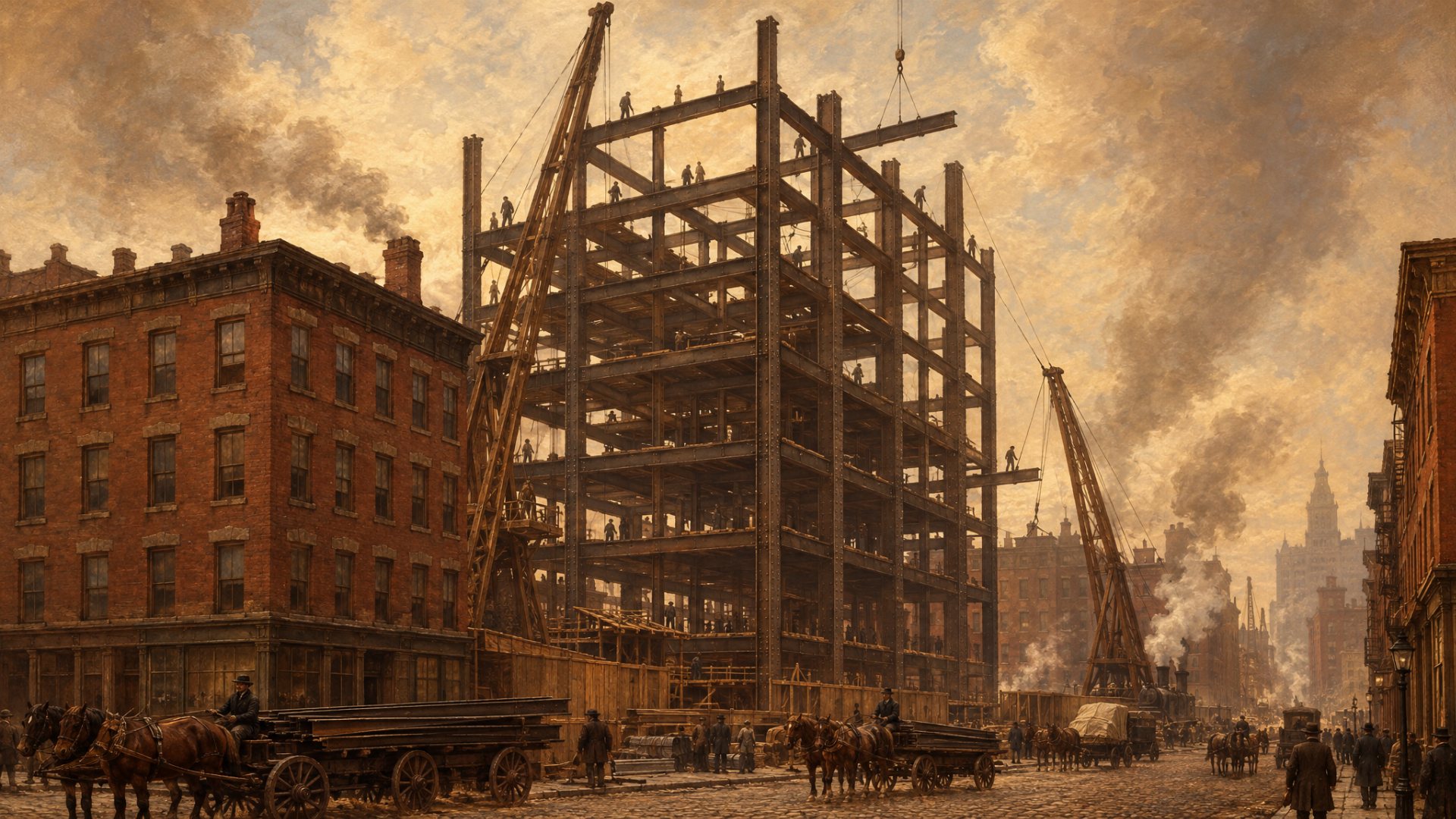
SI painting, made for this explainer: an illustration, not a photograph.
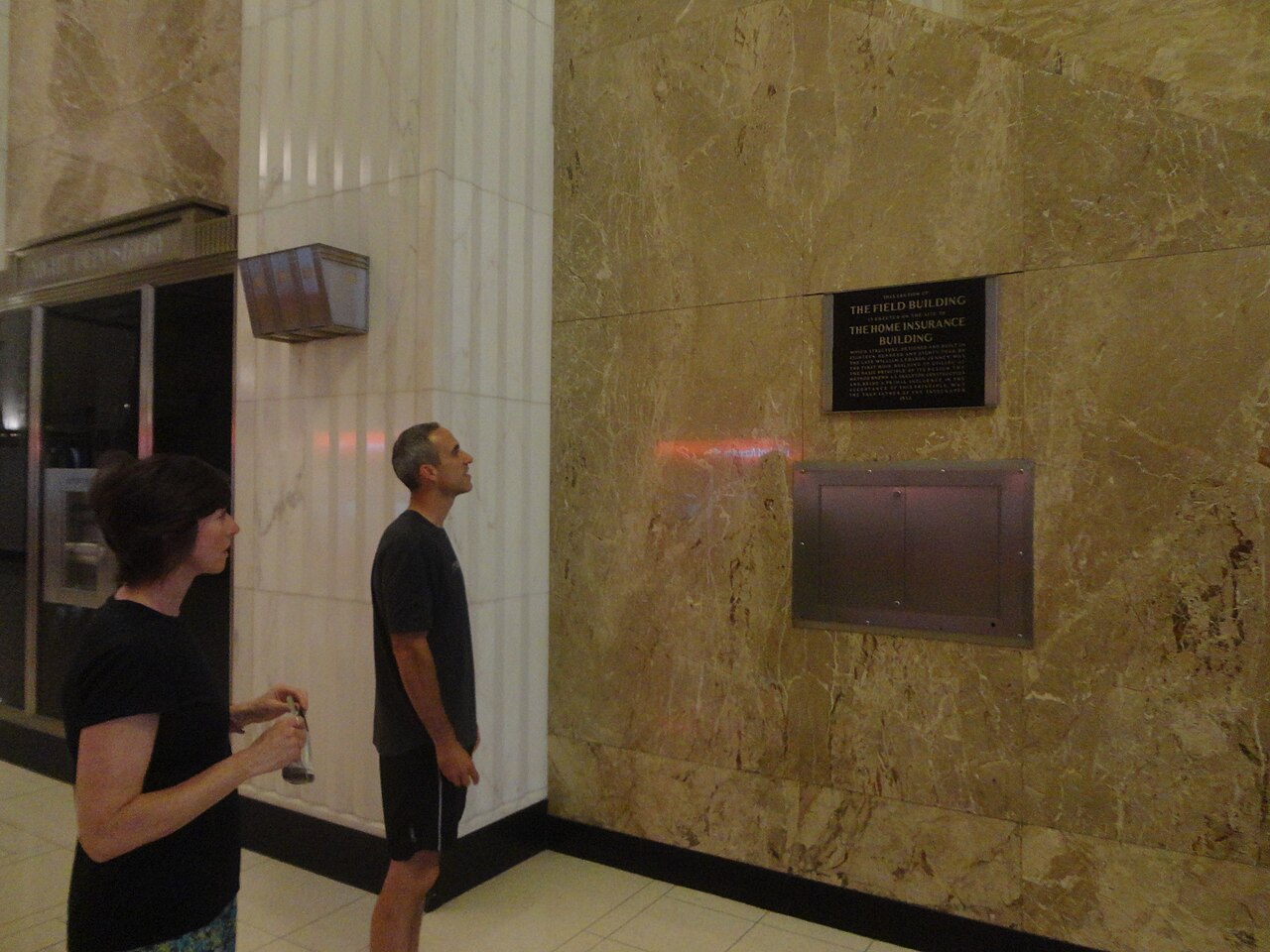
1885 · Chicago≈ 42.0 m
The steel frame and the Home Insurance Building
William Le Baron Jenney's ten-storey Home Insurance Building carried much of its weight on an iron and steel skeleton instead of thick masonry walls. Often called the first skyscraper; historians argue the title, since earlier buildings used iron frames in part. It was demolished in 1931.
Figures marked ≈ or "about" are estimates or disputed.
Marlin Keesler from Streamwood, IL (Wikimedia Commons) · CC BY 2.0
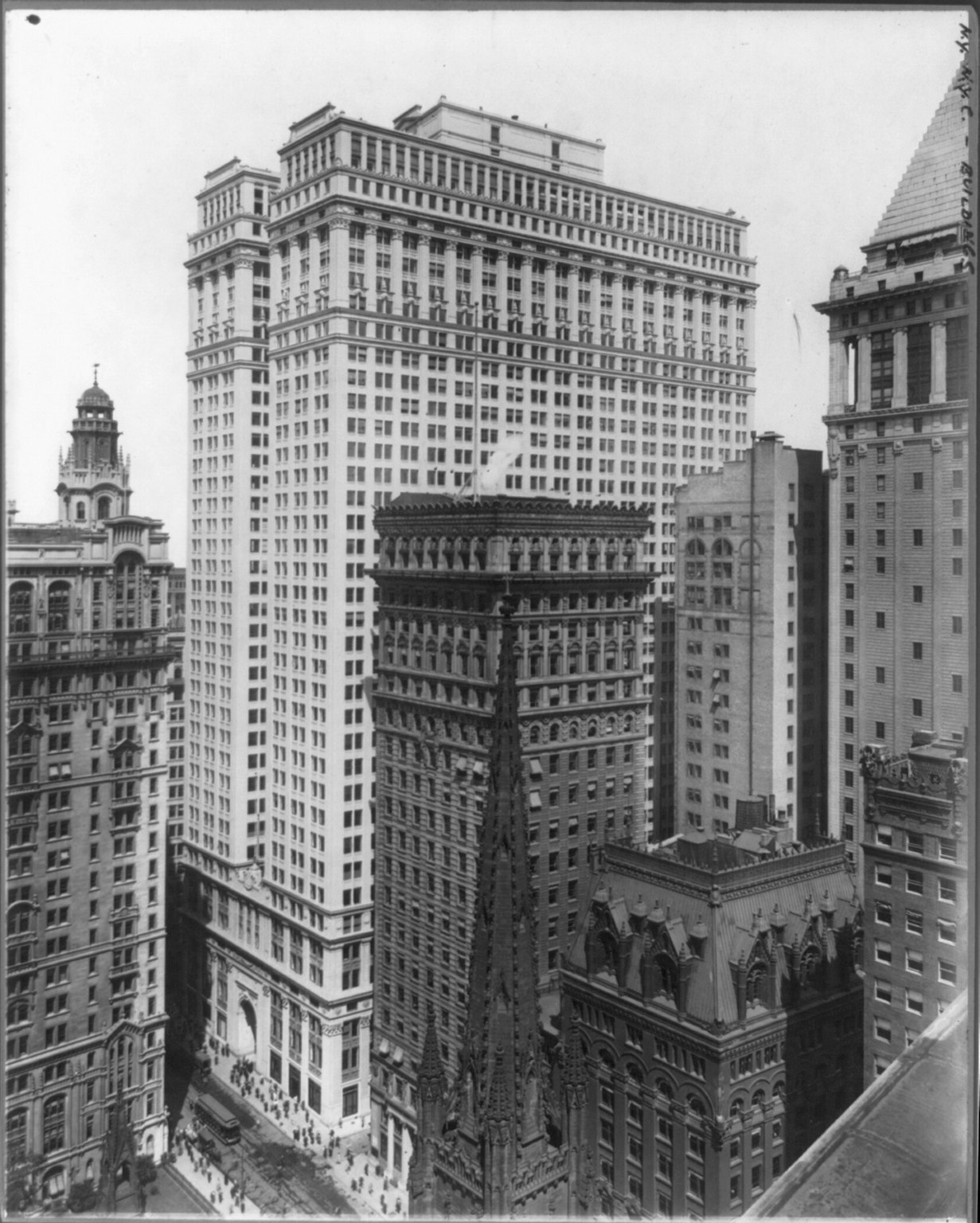
1915–1916 · New York164 m
The 1916 zoning resolution and the setback
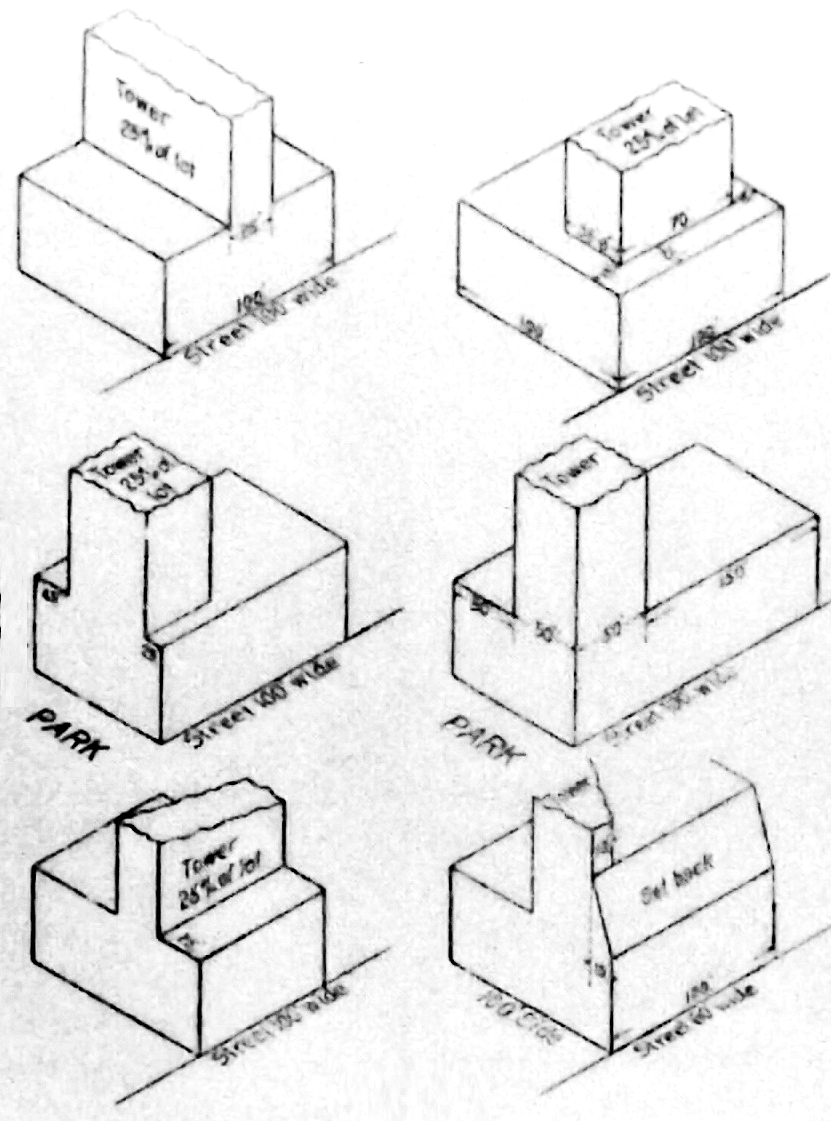
The 38-storey Equitable Building (1915) blocked light and air from its neighbors. New York answered with the 1916 Zoning Resolution, which made towers step back as they rose: the "wedding cake" shape of the 1920s. A rule, not an architect, drew the skyline.
Miscellaneous Items in High Demand, PPOC, Library of Congress (Wikimedia Commons) · Public domain
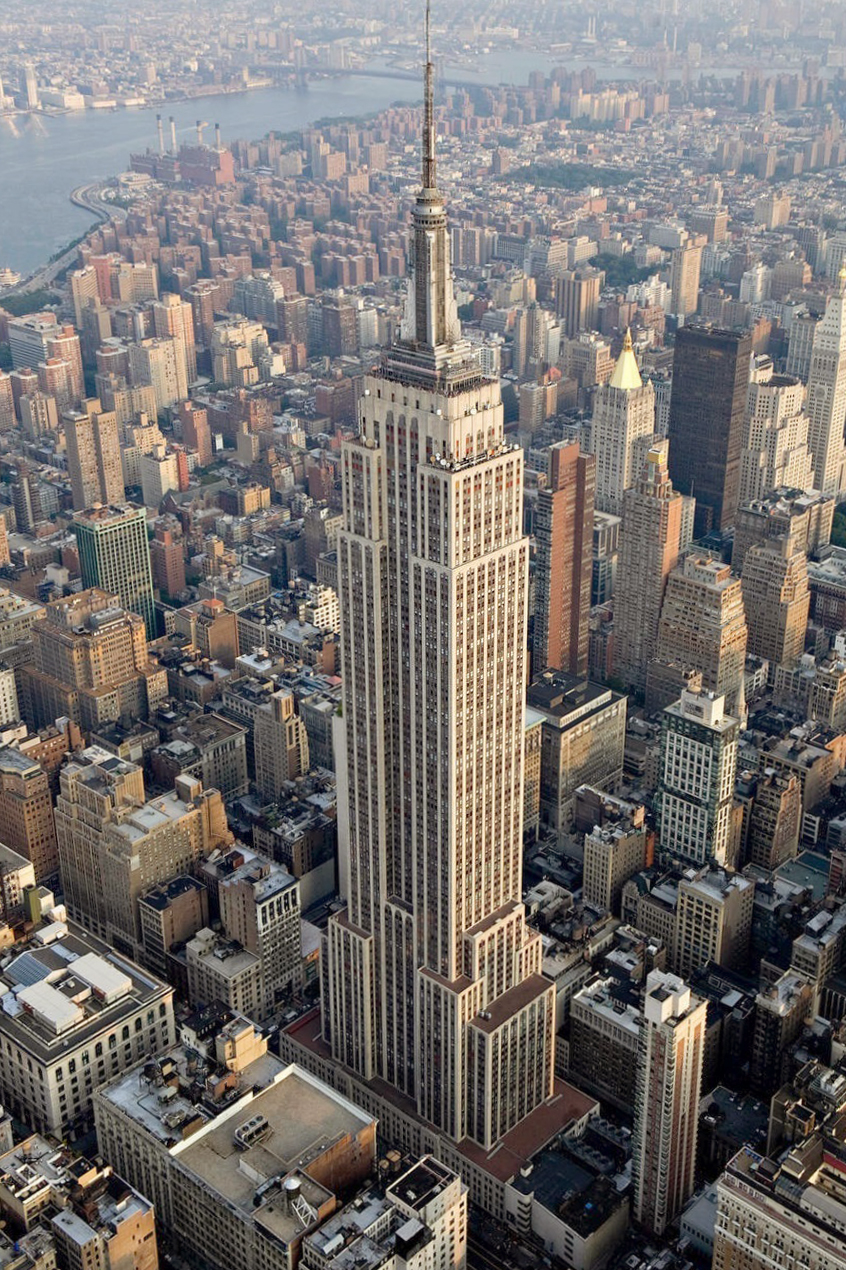
1930–1931 · New York381 m
The race: Chrysler and the Empire State
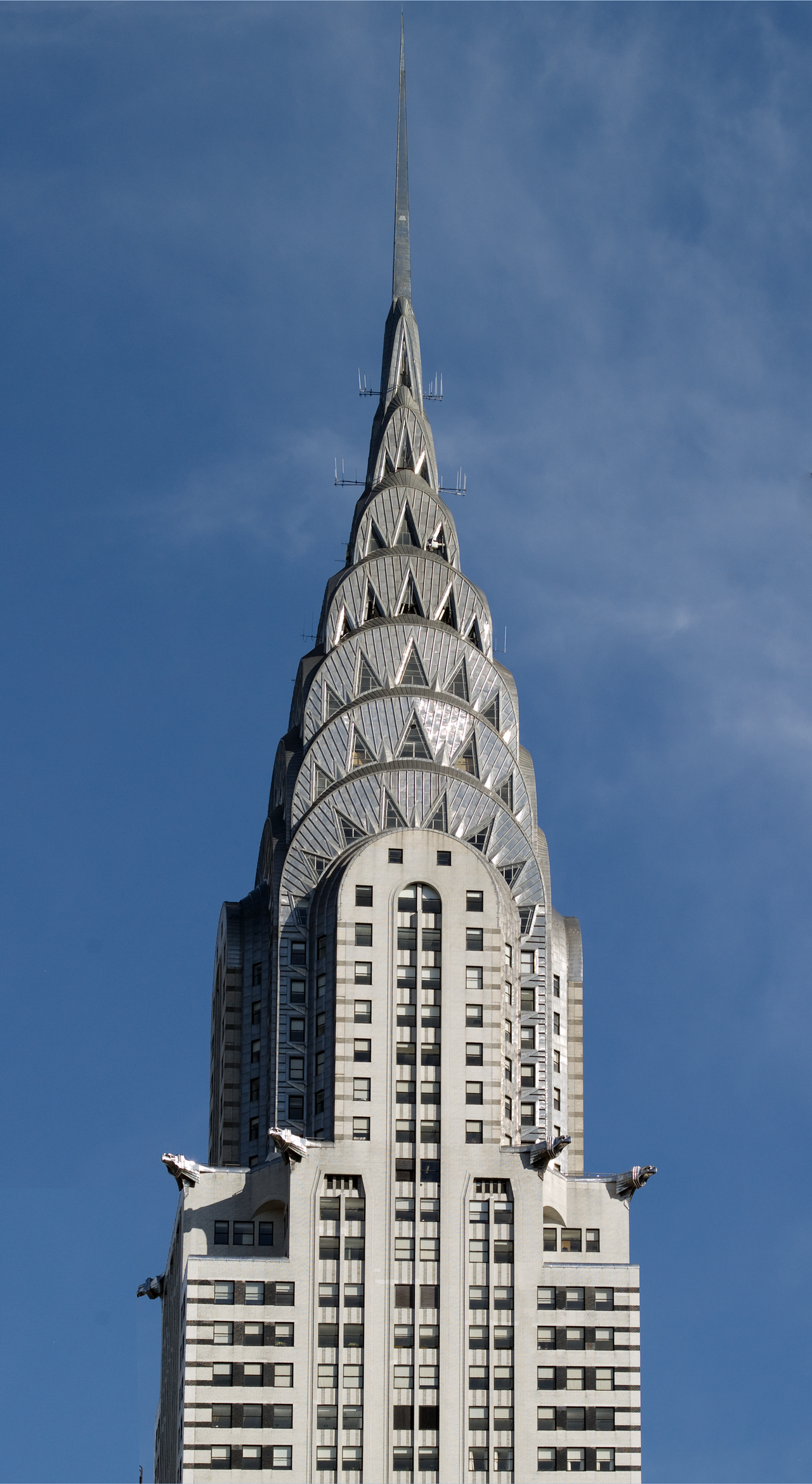
The Chrysler Building took the title in 1930 (319 m with its secret spire). The Empire State Building passed it in 1931 at 381 m to the roof, built in about 410 days during the Depression. It stood as the world's tallest until 1970.
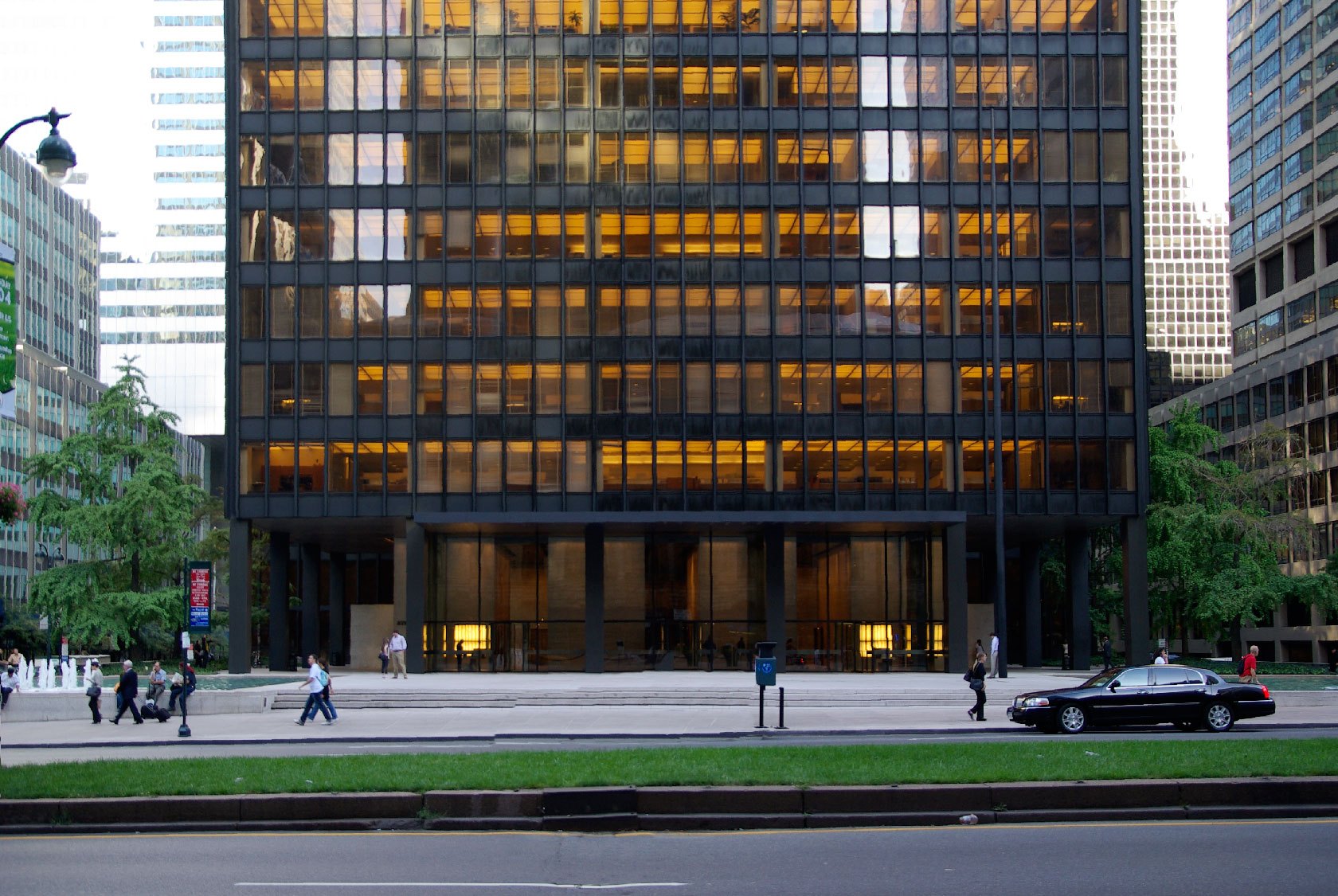
Mies van der Rohe's Seagram Building set its bronze-and-glass tower back behind an open plaza. New York's 1961 zoning rewarded that idea with extra floor area for public plazas, and with the first limits written as floor area ratio (FAR).
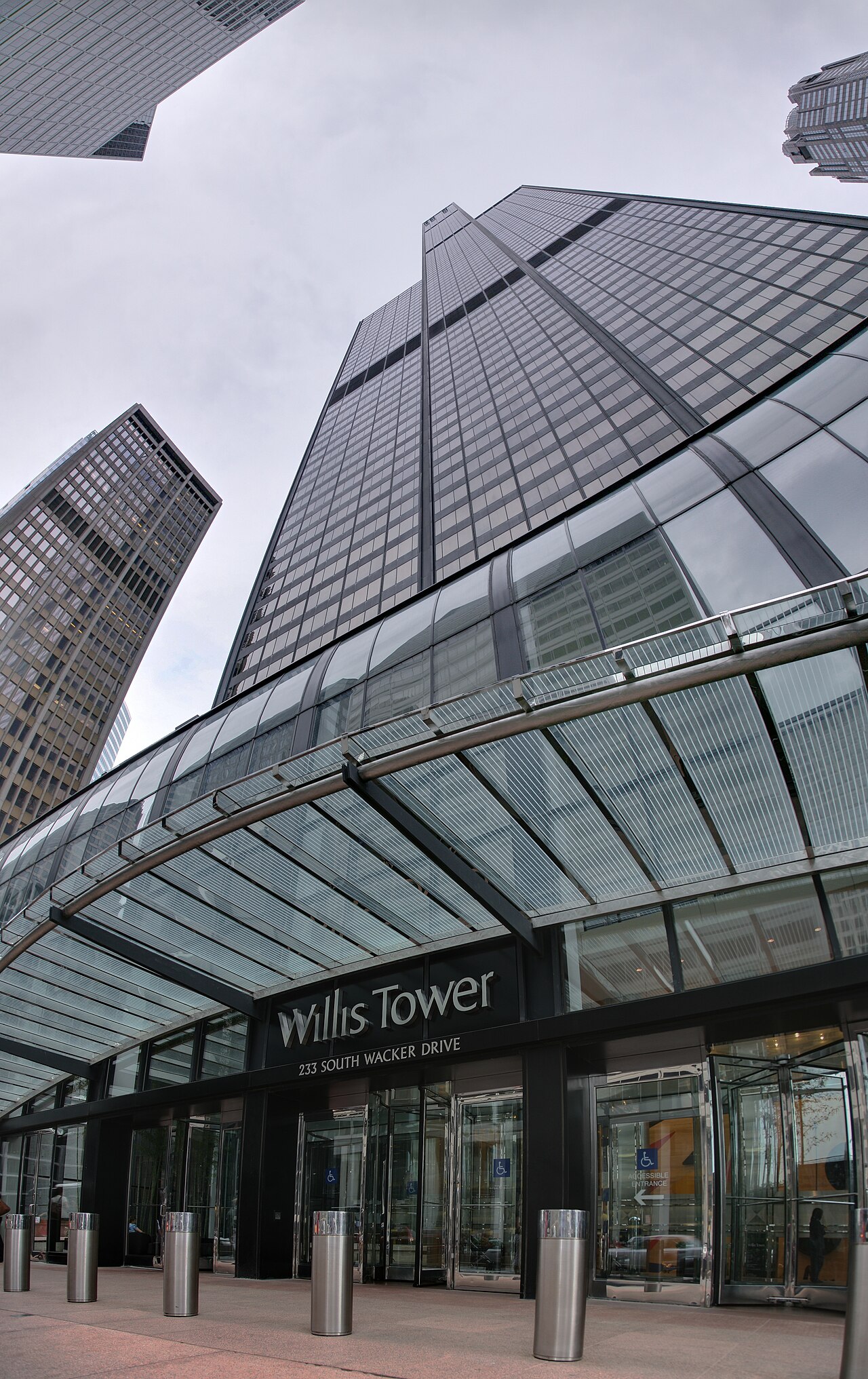
The engineer Fazlur Khan treated a whole tower as one stiff hollow tube against the wind: the framed tube, the X-braced trussed tube of the John Hancock Center (1969, 344 m) and the bundled tube of the Sears (now Willis) Tower (1973, 442 m). Less steel per floor made great height affordable.
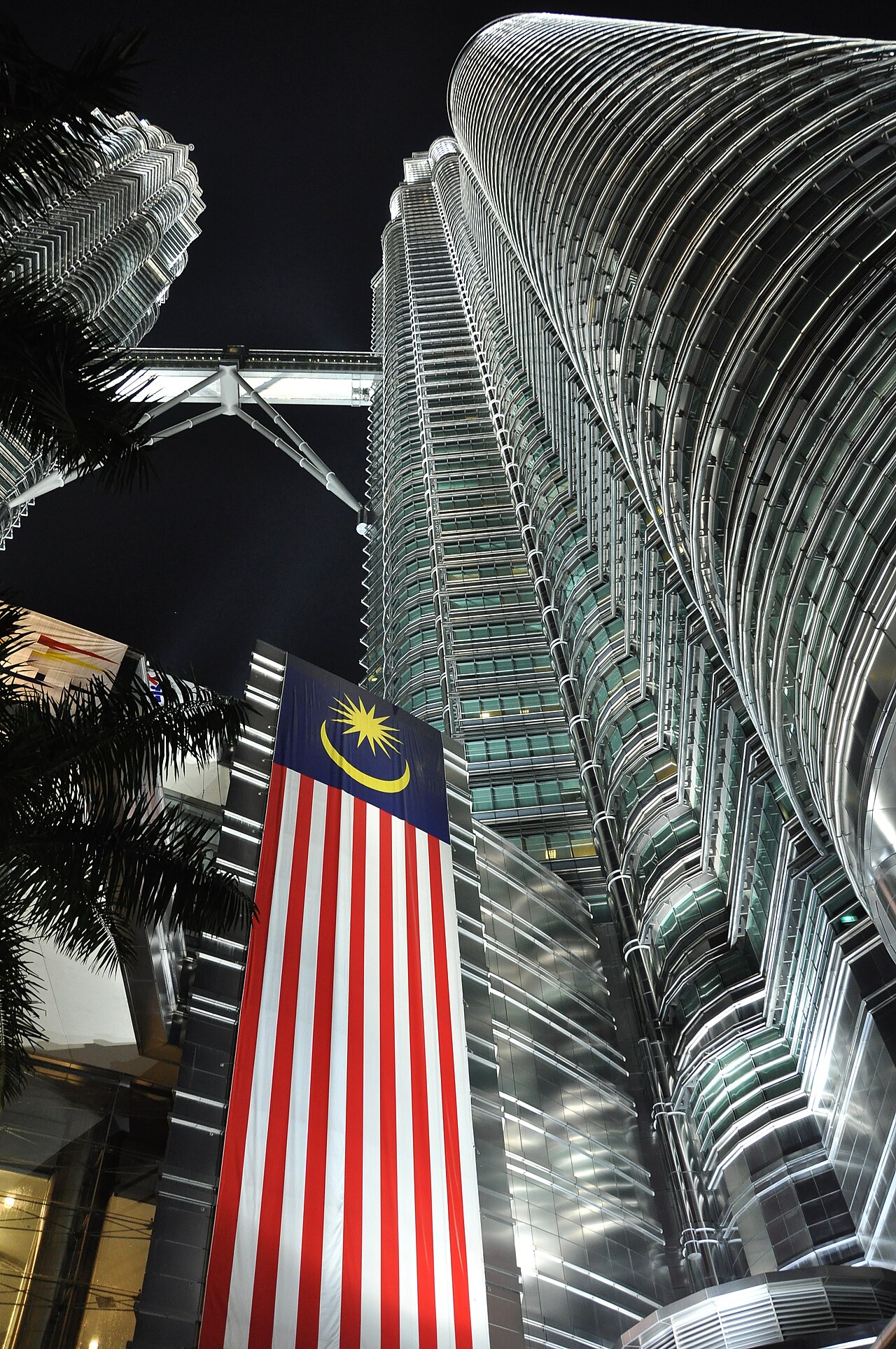
Petronas Towers (1998, 452 m), Taipei 101 (2004, 508 m, with a steel ball damper of about 660 tonnes hung near the top) and Shanghai Tower (2015, 632 m, twisting to cut wind loads). Most of the world's 300 m towers are now in Asia and the Gulf.
CEphoto, Uwe Aranas (Wikimedia Commons) · CC BY-SA 3.0
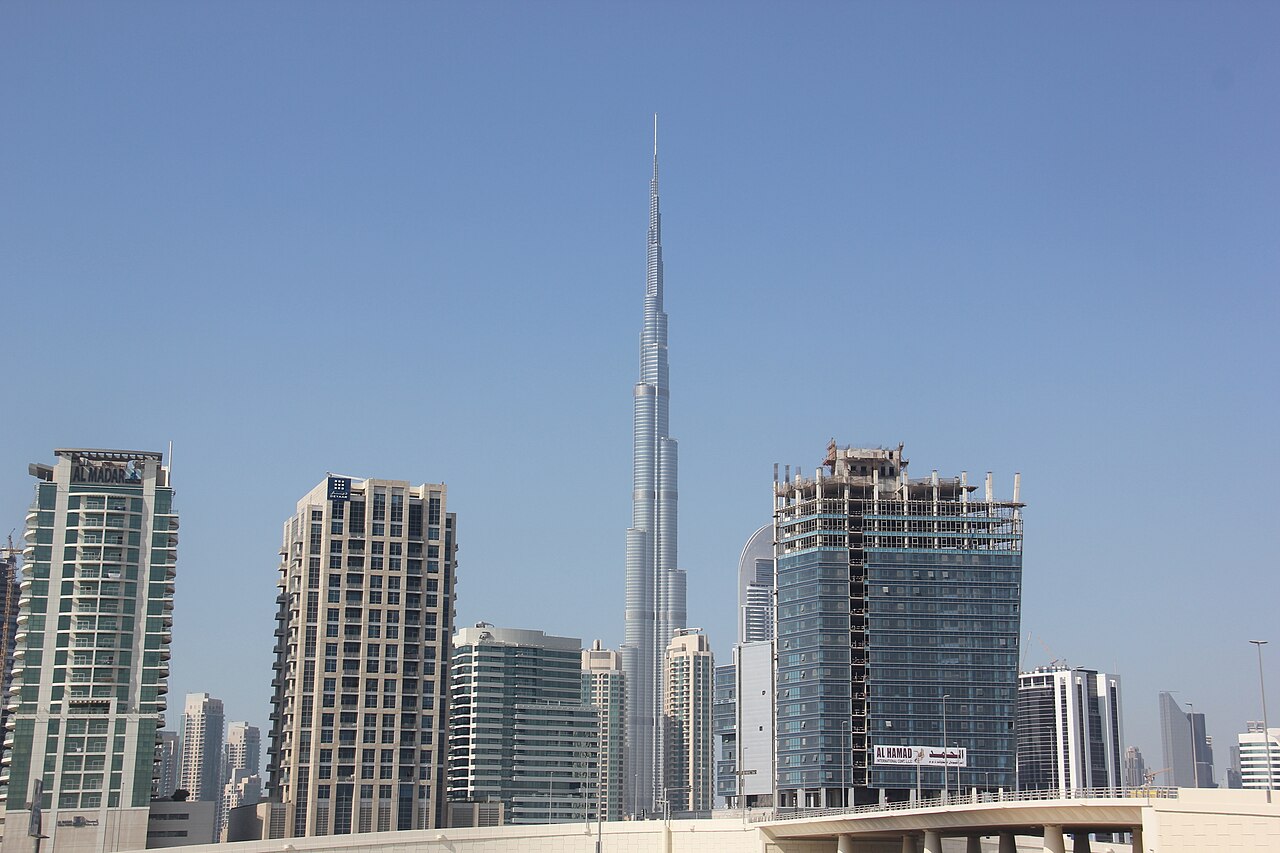
2010 · Dubai828 m
Burj Khalifa
828 m to the tip, the tallest building since 2010. A buttressed core: three wings brace a central concrete core like a tripod. Built as the centerpiece of a property development, it shows height as advertising for the land around it.
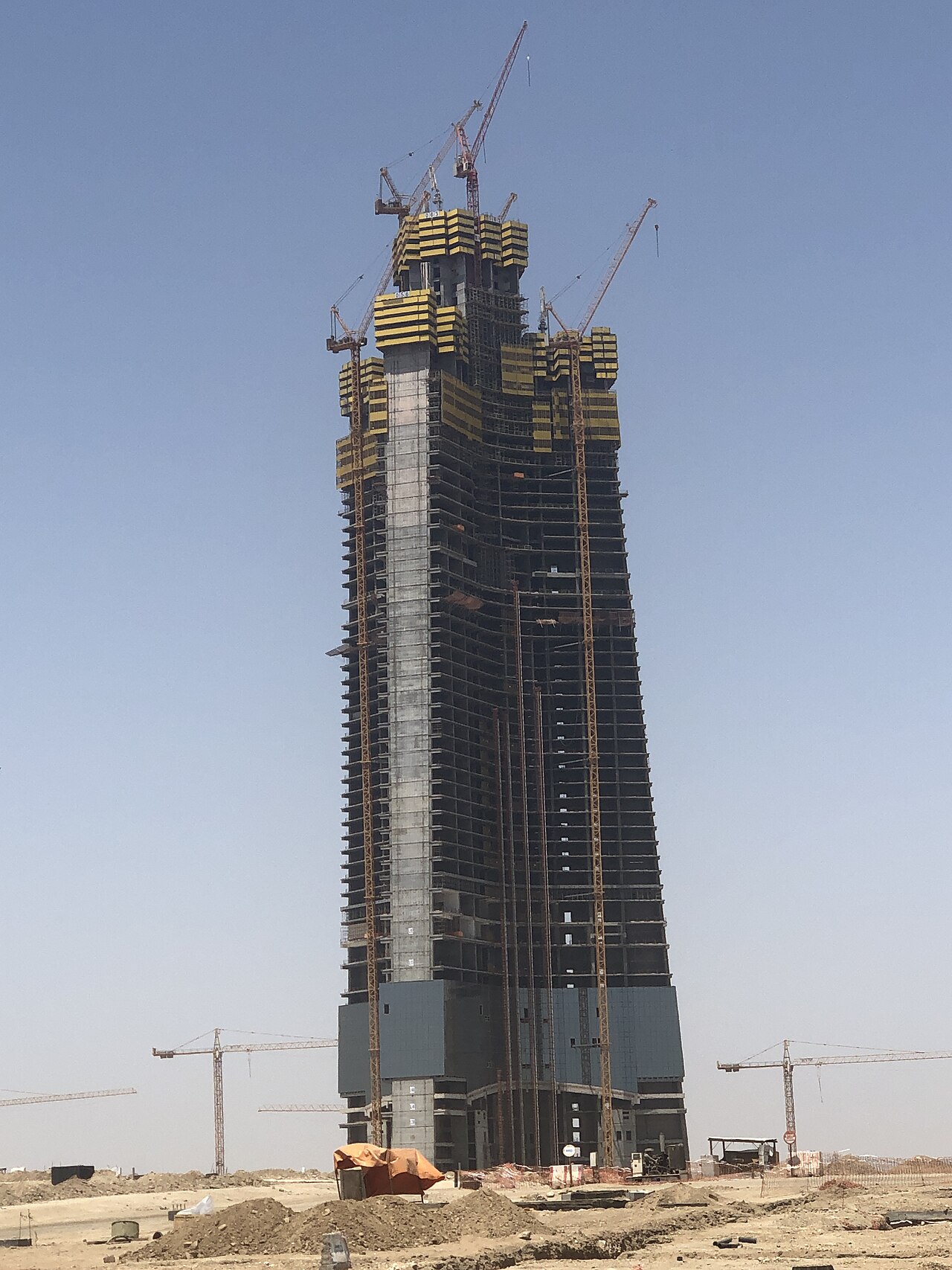
The Jeddah Tower (first called Kingdom Tower) stopped in 2018 and restarted in 2025, aiming above 1,000 m. Its completion date is a forecast, not a fact; check the current status before quoting a date.
Figures marked ≈ or "about" are estimates or disputed.
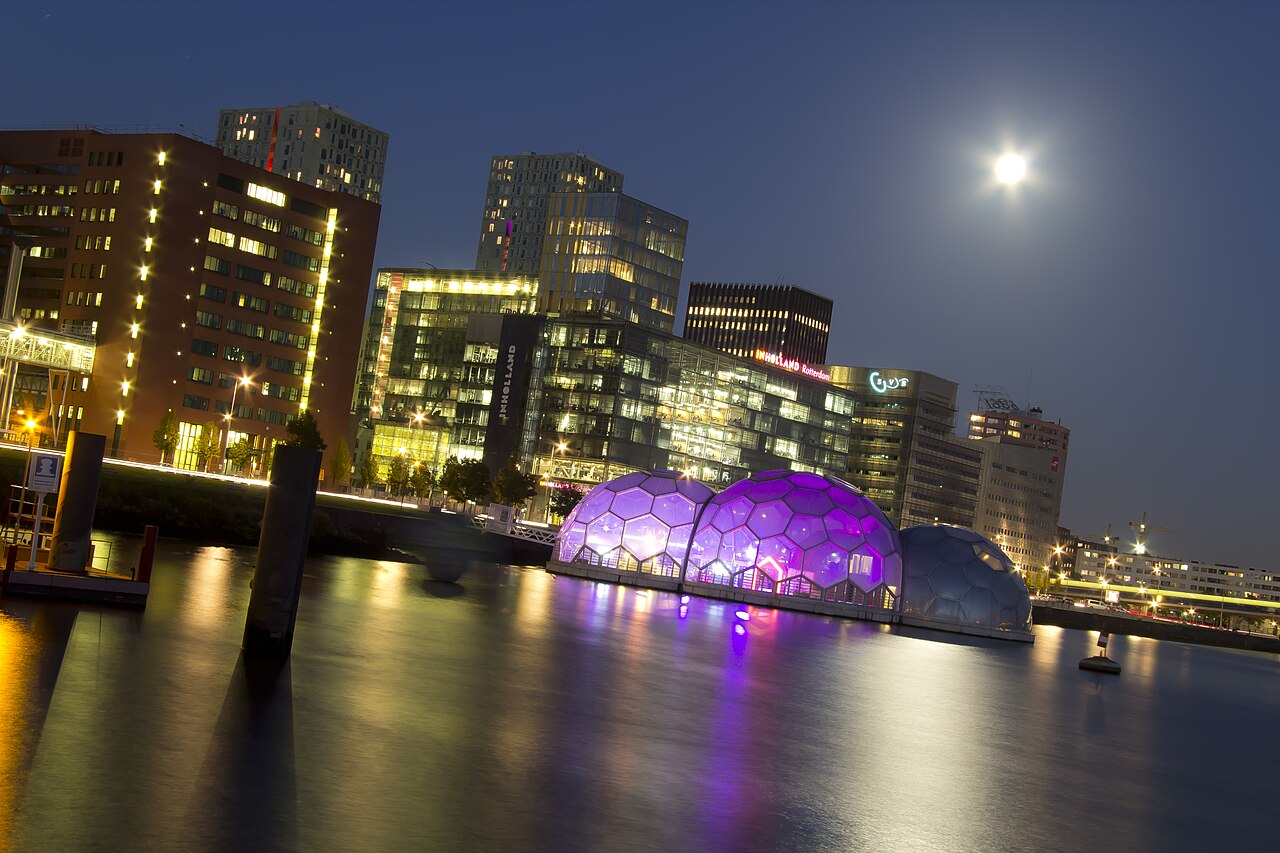
The bombing of 14 May 1940 destroyed the old center. Rotterdam chose to rebuild as a modern city instead of copying the old one, and it is now the Netherlands' high-rise city: the Erasmus Bridge (1996), De Rotterdam (2013) and the Zalmhaven tower (2022, about 215 m). See the Water and land rooms for the port that pays for it.
Figures marked ≈ or "about" are estimates or disputed.
Luke Price from Rotterdam, Netherlands (Wikimedia Commons) · CC BY 2.0
Part two · live from the research databaseWhen did America build tall?
Count every building in the database by the decade it was finished. The bars show how many reached 150, 200 and 300 m. Look for the booms: the 1920s, the 1960s to 1980s, and the 2010s. Then look for the gaps: the Depression and war years, and the early 1990s after a property crash.
Office or home? Towers of 150 m and up, by decade
Primary use as recorded in the database; buildings with no recorded use are left out. In the 1980s offices led; since 2000 residential towers outnumber office towers.
The tallest in the database
Building
City
m
Year
Use
One World Trade Center
New York, NY
541
2014
Office
Central Park Tower
New York, NY
472
2020
Residential
Willis Tower
Chicago, IL
442
1973
Mixed-Use
111 West 57th Street
New York, NY
435
2021
Residential
51 EAST 42 STREET, Manhattan
New York, NY
427
2017
Residential
One Vanderbilt
New York, NY
427
2020
Office
432 Park Avenue
New York, NY
426
2015
Residential
Trump International Hotel and Tower
Chicago, IL
423
2009
Mixed-Use
JP Morgan Chase World Headquarters
New York, NY
423
2025
Office
30 Hudson Yards
New York, NY
387
2019
Office
Empire State Building
New York, NY
381
1931
Mixed-Use
Bank of America Tower
New York, NY
366
2009
Mixed-Use
Live query; names as stored. The database is U.S.-only, so Dubai and Shanghai appear on the cards, not here.
Go deeper
Lessons:APHG 19 · Why the vertical pushPreviewAPHG 18 · Inside the cityPreview
Seven forces show up again and again. No single one explains a skyline; the tallest places are where several line up at once.
1964 · theory
Land rent and the bid-rent curve
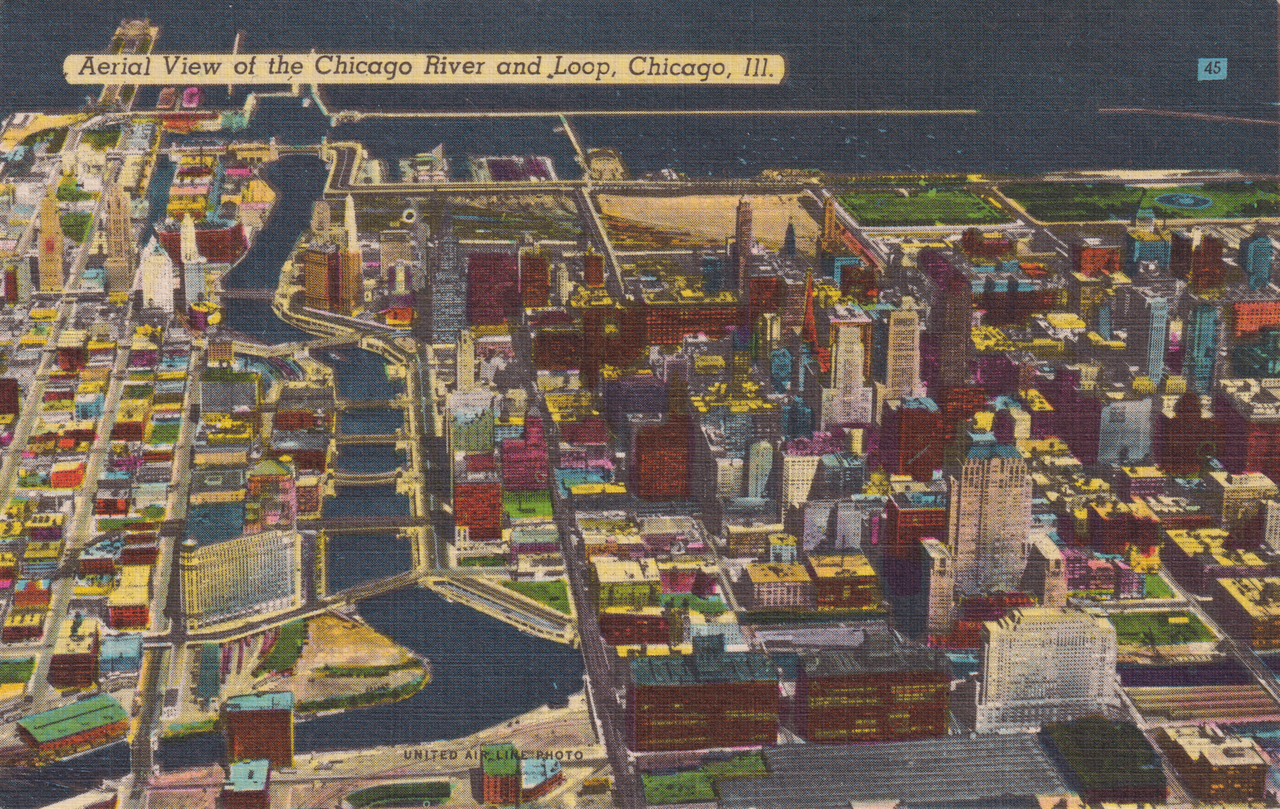
William Alonso's model: the closer to the center, the more each user will pay for a square metre, because closeness saves travel and brings customers. Where land costs the most, a builder stacks more floors on it, swapping steel (capital) for land. Height is how a city spends expensive ground.
US postcard publisher (Wikimedia Commons) · Public domain
theory and evidence · every CBD
Agglomeration: why firms crowd together
Banks, lawyers and headquarters gain from being a short walk apart: faster deals, shared workers, ideas passed in lobbies. That value turns into rent, and rent turns into height. Remove the reason to be close and the push upward weakens.
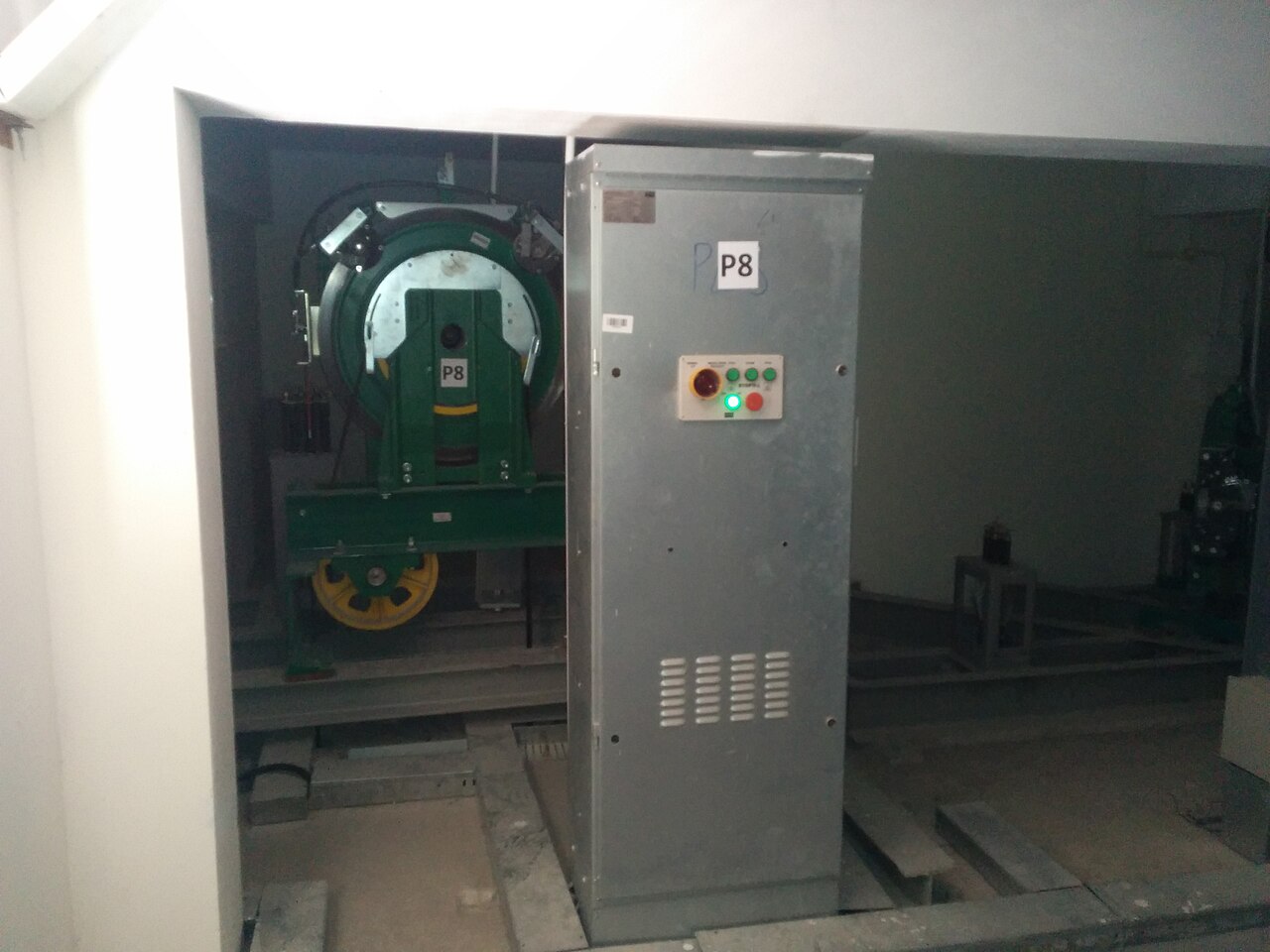
Every era has a practical ceiling set by how people move and how the frame stands: hydraulic and early electric lifts, then express cars and sky lobbies, then light carbon-fiber ropes. Each new step lowers the share of every floor lost to shafts and raises the height that pays.
FAR divides a building's floor area by its lot area: FAR 10 on a 1,000 m² lot allows 10,000 m² of floors, as ten full floors or forty thin ones. Height caps, setbacks, sky-exposure planes and bonuses for plazas or housing decide which. Air rights let one lot sell unused floor area to another.
Commission on Building Districts (Wikimedia Commons) · Public domain
1999 · finance
Money cycles and the "skyscraper index"
Andrew Lawrence noticed in 1999 that record towers often open around financial crises (the Empire State in 1931, the Petronas Towers in 1998, the Burj Khalifa in 2010). Cheap credit at the top of a boom pays for the boldest towers. Economists still argue whether the pattern predicts anything; treat it as a debate, not a law.
Figures marked ≈ or "about" are estimates or disputed.
A tower can be worth more as a symbol than as floor space: a company logo against the sky, a city's claim to be global, a family's tower in medieval Tuscany. Prestige height often sits in spires and crowns that hold no floors, which is why height is measured several ways.
Carol M. Highsmith (Wikimedia Commons) · Public domain
2015–2021 · New York472 m
Pencil towers and Billionaires' Row
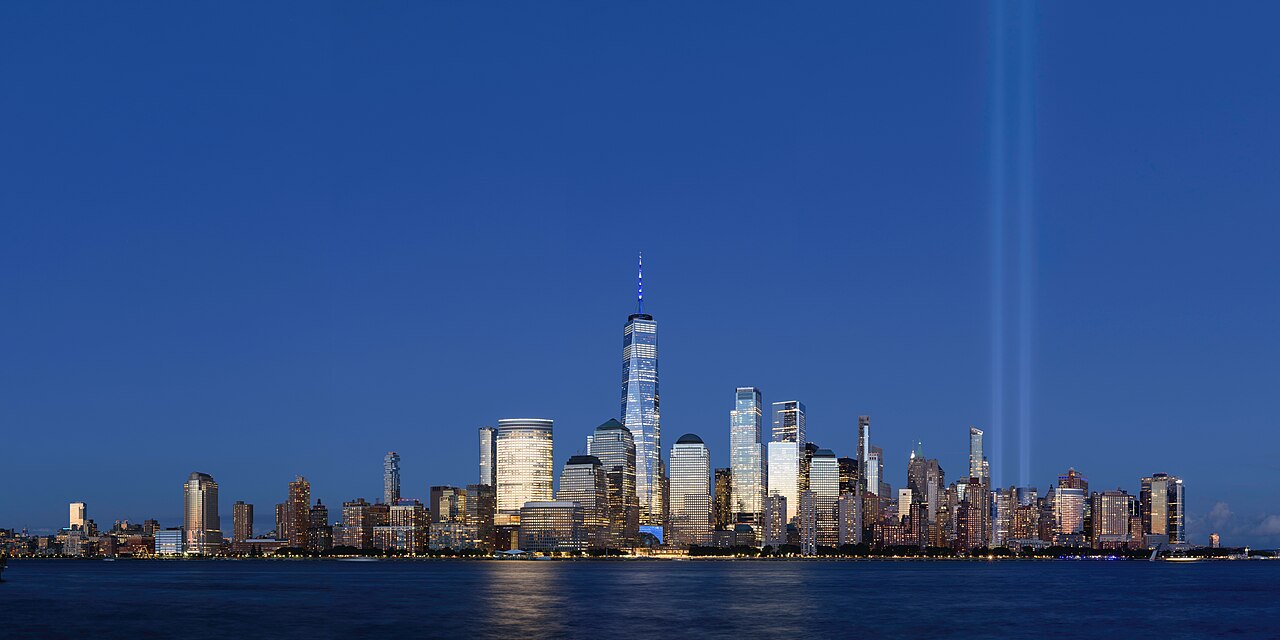
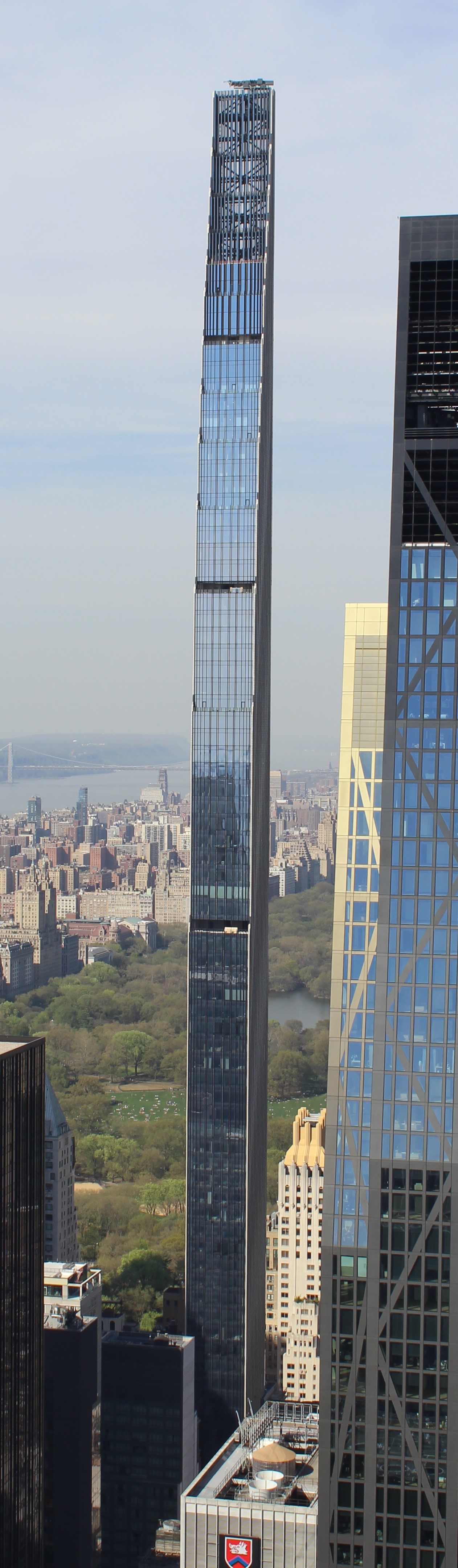
Very thin luxury apartment towers along 57th Street: 432 Park Avenue (2015, 426 m), Central Park Tower (2020, 472 m) and 111 West 57th Street (2021, 435 m, about 1 to 24 in slenderness). Views over Central Park sell by the floor, and bought air rights stack them up. In the research database, the tallest residential towers are all from this decade.
Percival Kestreltail (Wikimedia Commons) · CC BY-SA 4.0
2020 onward · US downtowns
Offices into homes after 2020
Remote and hybrid work left many office towers part-empty. Cities from New York to Calgary now offer incentives to convert older offices into apartments, though deep floor plates make windows and plumbing hard. Whether downtowns tilt from office to residential height is a live question in the research.
You own a 2,000 m² lot and will build floors of 1,000 m². Every extra floor earns rent but costs more than the one below it (taller means deeper foundations, stronger frames, more elevators eating into the floor). You stop where one more floor would cost more than it earns, unless the zoning stops you first. Move the sliders.
A teaching model, not a forecast: rent falls with distance as in the bid-rent curve, each era sets a practical ceiling and a cost curve, and zoning caps the floor area. Real projects add financing, demand, wind, flight paths and politics. The point is the shape of the answer: central land, better technology and looser zoning all push the chosen height up.
Look insideAnatomy of a supertall
Click a part of the tower
Each part answers one problem of great height: weight, wind, sway or the time it takes to get upstairs.
Close to homeFlorida and Tampa Bay
2000s onward · Miami, Florida265 m
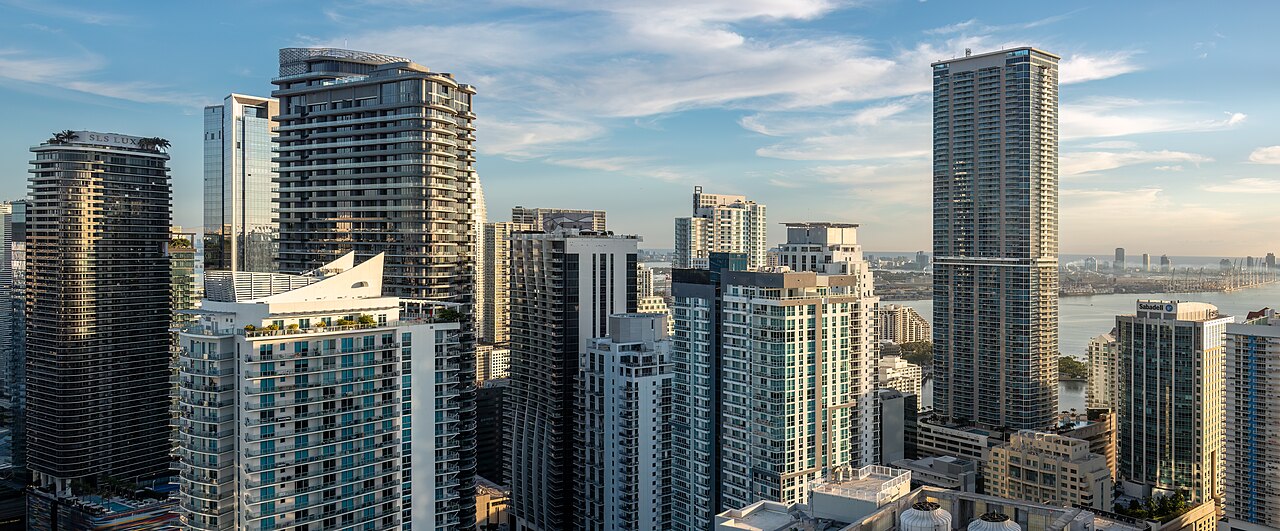
Miami and Brickell
Miami holds most of Florida's tall buildings; in the research database the tallest is about 265 m (Panorama Tower, 2018). Condominium towers dominate, sold to buyers from across the Americas, and flight paths from the airport cap the heights.
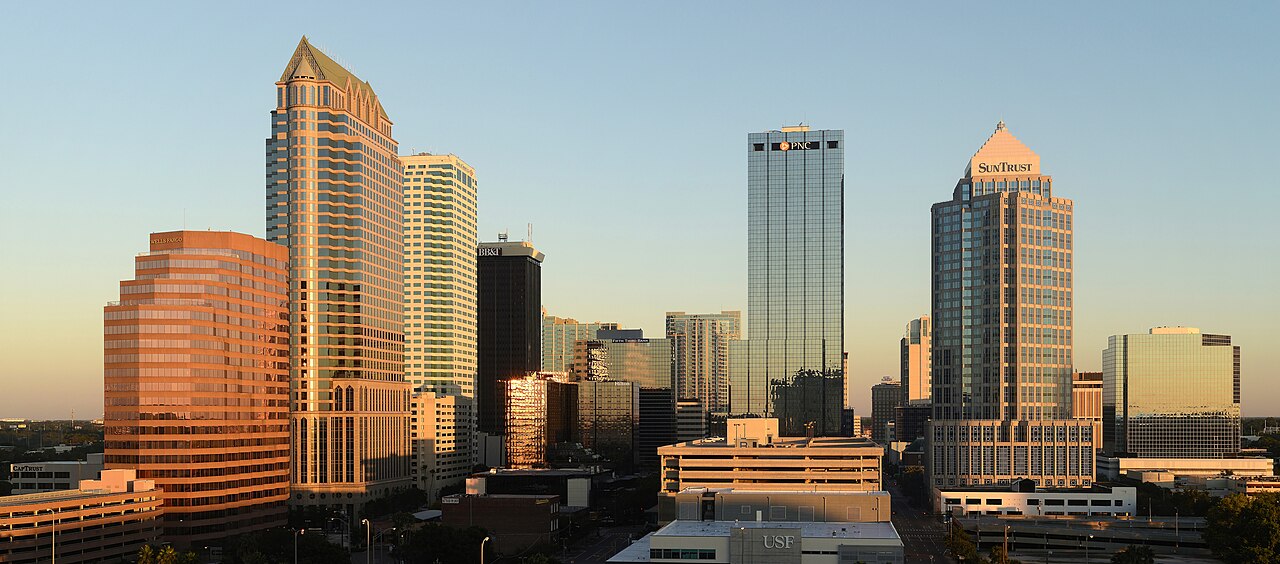
Tampa's tallest tower is 100 North Tampa (1992, about 176 m). Water Street Tampa and St. Petersburg's new condominium towers add height near the bay, an hour up the road from Bradenton.
After Hurricane Andrew (1992), Florida wrote a statewide building code (in force 2002) with the strictest wind rules in the country, including a High-Velocity Hurricane Zone in Miami-Dade and Broward. Towers here are designed for wind loads that change their shape, glass and cost.
United States Air Force (Wikimedia Commons) · Public domain
Florida cities in the database (live)
City
100 m and up
150 m and up
Tallest (m)
Miami
108
64
265
Tampa
16
3
176
Jacksonville
15
4
188
Tallahassee
1
0
105
St. Petersburg and Sarasota towers are not yet in the database. More in the Miami field report.
For younger visitors (K–5): Why do cities build up?
Imagine one small yard and lots of friends who all want to play in it. If you build a playhouse with many floors, everyone fits! Cities do the same thing downtown, where land is scarce and costs a lot. Safe elevators and strong steel frames make tall buildings possible.
Try this: stack blocks as high as you can. What makes the tower wobble? What makes it stronger? (A wide base, a strong middle "core", and cross-bracing.)
Three quick questions (3 questions · runs in your browser, nothing is sent)
Lessons:APHG 19 · Why the vertical pushPreviewAPMIC 19 · Land, rent and the bid-rent curvePreviewAR4 11 · Freeing the WallPreviewAR4 12 · Cooled Air and the Glass BoxPreviewMA5 37 · Capstone: Survey a TowerPreviewAPPHY1 22 · Density, pressure and Archimedes' principlePreview
Read and watch: David Macaulay, Unbuilding (1980, the Empire State Building taken apart on paper; grades 4–8) and Building Big (PBS, 2000); Jason Barr, Building the Skyline (Oxford, 2016, for older students and teachers); Mohsin Hamid's novel How to Get Filthy Rich in Rising Asia (2013, grades 11–12) follows a man whose fortune rises with a city's towers.
Quiz: How tall? (10 questions · runs in your browser, nothing is sent)
Council on Tall Buildings and Urban Habitat, The Skyscraper Center (heights and dates, checked 2026-11): skyscrapercenter.com; height criteria: ctbuh.org
The Skyscraper Museum, New York: skyscraper.org; Carol Willis, Form Follows Finance (Princeton Architectural Press, 1995).
Jason M. Barr, Building the Skyline: The Birth and Growth of Manhattan's Skyscrapers (Oxford, 2016); Barr, Mizrach and Mundra, "Skyscraper height and the business cycle", Journal of the Asia Pacific Economy (2015): doi
William Alonso, Location and Land Use (Harvard, 1964); Edward Glaeser, ed., Agglomeration Economics (NBER, 2010).
NYC Department of City Planning, zoning history and glossary: nyc.gov
Roman height limits: Strabo, Geography 5.3.7 (Augustus); Aurelius Victor, Epitome de Caesaribus 13.13 (Trajan), via LacusCurtius.
UNESCO World Heritage: Old Walled City of Shibam (1982), Historic Centre of San Gimignano (1990).
Florida Building Code history: Florida Building Commission, floridabuilding.org
Urbanicity building database (buildings.buildings), read live on every page load.
newSchoolWorks.com · The Museum of Everyday Living · Bradenton, FL · SI paintings made for this explainer; photographs from Wikimedia Commons under the licences shown on each card.